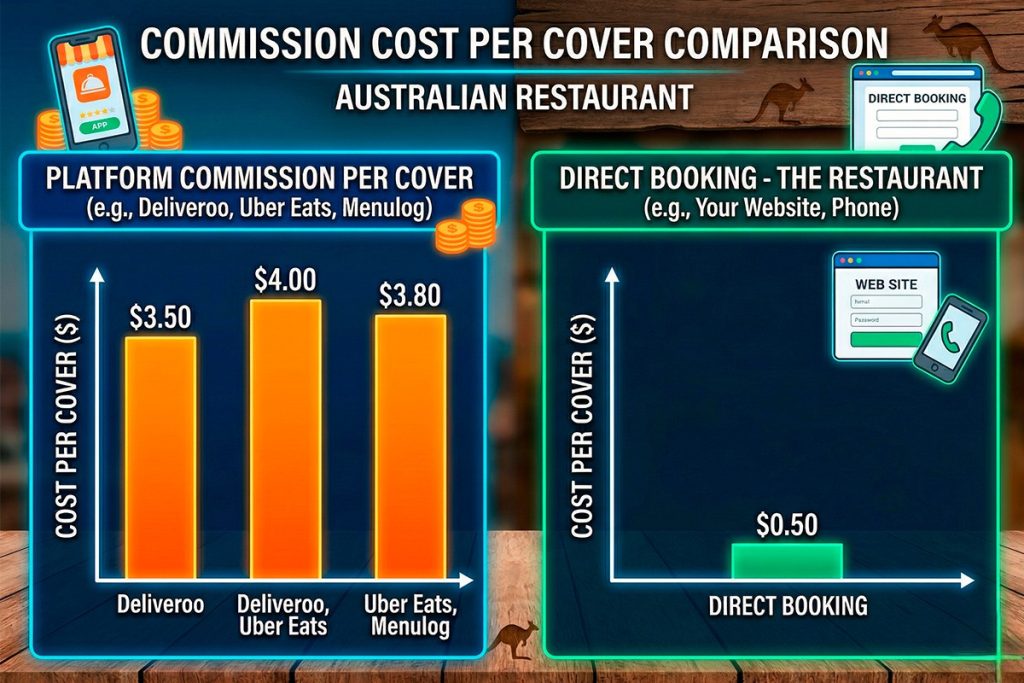
Every reservation that comes through OpenTable, Quandoo, or Dimmi costs you money. Not just the monthly subscription — the per-cover fee that gets charged every time a guest books through the platform. For a restaurant doing 200 covers a week, that adds up to thousands of dollars a year in fees paid to a platform for guests who might have booked directly if you’d given them an easier way to do it.
The good news is that shifting reservations away from cover-charging platforms isn’t complicated. It requires the same thing that reducing OTA dependency requires for hotels: a direct booking experience that’s easy enough that guests don’t reach for the platform out of habit, and a reason to book direct that the platform can’t offer.
Why guests default to platforms in the first place
Before fixing the problem, it helps to understand why it exists.
Guests use OpenTable and Quandoo for the same reason travellers use Booking.com — convenience and trust. The platform is familiar. The booking flow is fast. They can see availability across multiple restaurants in one place without hunting for individual websites. And they know the confirmation will arrive reliably.
None of that is impossible to replicate on your own site. But most restaurant websites make it harder than it needs to be — a booking link buried in the navigation, a widget that doesn’t load properly on mobile, a confirmation email that goes to spam. Fix those things and the platform’s convenience advantage largely disappears.
1. Make your direct booking experience better than the platform’s
The first step is purely mechanical: make booking directly through your website faster and easier than booking through a platform.
That means a reservation button visible on your homepage without scrolling — not tucked into a contact page or a dropdown menu. A booking widget that loads natively on the page rather than opening in a new tab or redirecting to an external site. A mobile experience that completes in under two minutes. And a confirmation email that arrives immediately, looks professional, and includes everything the guest needs — date, time, party size, any special notes, your address and parking details.
Test your own booking flow on your phone right now. If it takes more than four taps from your homepage to a confirmed reservation, or if anything feels slow or unclear, you’re losing direct bookings to platforms that have invested heavily in making their checkout seamless.
The booking engine matters here. Restaurant platforms like ResDiary, Bopple, and Now Book It offer direct booking integrations that sit natively on your site, connect to your POS, and send professional confirmations — without the per-cover fee. The monthly cost of a direct booking engine is typically recovered in the first few bookings it generates.
2. Give guests a reason to book directly
A guest who knows about both options needs a reason to choose the one that takes slightly more effort than clicking through a familiar platform.
The most effective direct booking incentives for restaurants are experience-based, not discount-based. A complimentary amuse-bouche for direct bookers. Priority seating for guests who contact you directly. Access to a special tasting menu not available through platforms. A guaranteed window table for bookings made via your website. These are low-cost gestures that carry real perceived value — and they create a sense that booking direct gets you something the platform can’t.
Feature the incentive prominently on your website — on the homepage, on the reservations page, and in your email footer. Frame it as an insider benefit rather than a promotion. “Book directly with us and arrive to a glass of something special” lands differently than “10% off when you book online.”
3. Capture and use your guest database
Every guest who books directly is an opportunity to build a relationship that costs nothing to maintain and generates repeat visits at zero incremental marketing cost.
Most restaurants collect email addresses at the point of booking and do nothing with them. That’s a significant missed opportunity. A simple email sequence — a post-visit thank you with a review request, a monthly newsletter with upcoming events and seasonal menu news, a birthday message if you collected that information — keeps your restaurant in the guest’s awareness between visits and drives repeat bookings that don’t go through a platform.
Segment your list over time. Guests who’ve visited three or more times are your most valuable cohort — they know your food, trust your team, and are the most likely to respond to an early-access offer for a special event or a new menu launch. Guests who visited once and haven’t returned are worth a re-engagement campaign. Treat the database as a revenue asset, not an admin record.
4. Optimise your Google Business Profile for direct reservations
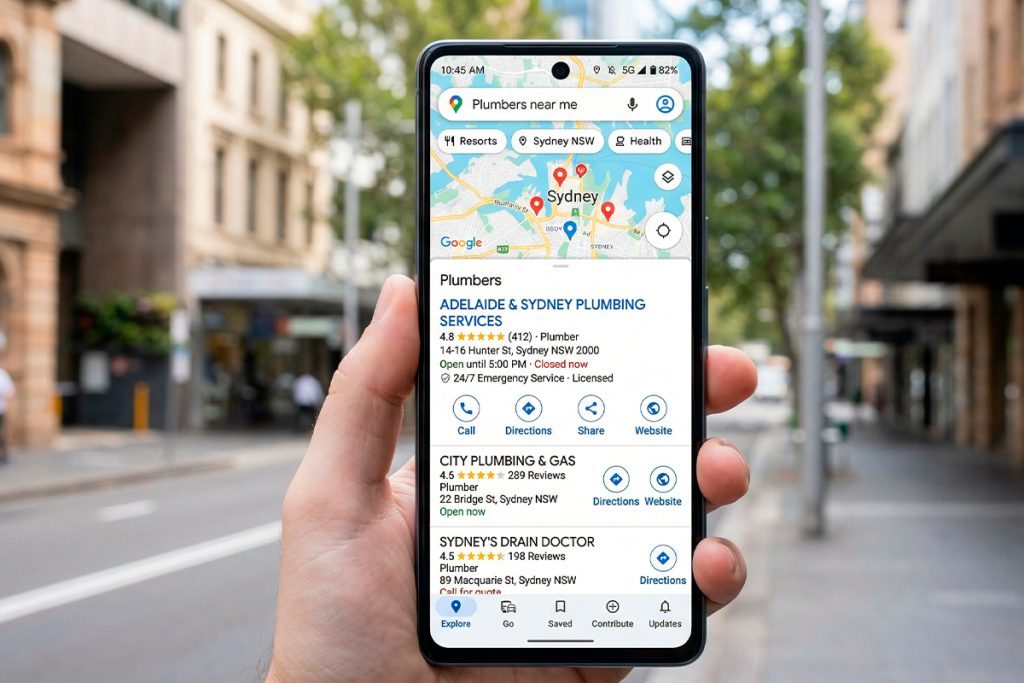
Your Google Business Profile is where a significant percentage of restaurant reservations begin — a guest searching for your restaurant by name, or searching for “fine dining [suburb],” sees your GBP before anything else.
The reservation link in your GBP should go directly to your booking page — not to OpenTable, not to your homepage, not to a contact form. Every guest who clicks “reserve a table” from your Google listing and lands on your direct booking page is a potential commission-free reservation.
Check this now. Open Google Maps, search your restaurant name, and click the reservation button. Where does it go? If it goes anywhere other than your direct booking page, fix it in your GBP dashboard under “Reservations” or “Bookings.”
While you’re in the dashboard, make sure your hours are current, your photos are recent, and your menu link is active. A GBP that looks maintained converts at a meaningfully higher rate than one that was last updated when you opened.
5. Run Google Ads to capture direct booking intent
When a guest searches “book fine dining restaurant Melbourne Saturday night,” they’re ready to reserve. That’s the moment to capture them on your own booking page rather than a platform listing.
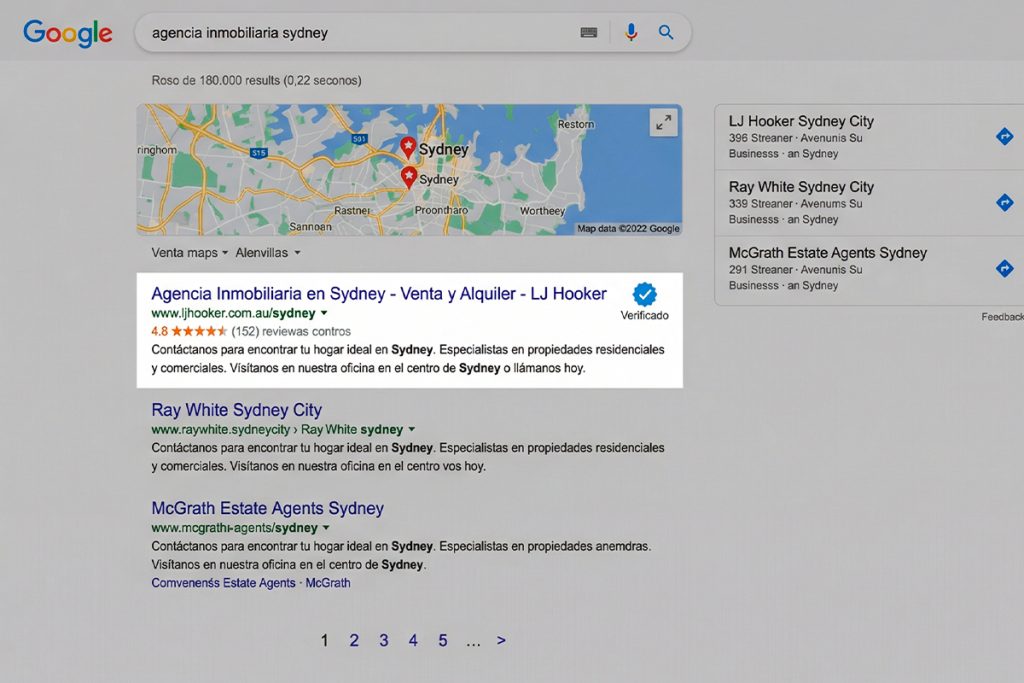
A simple Google Search campaign targeting your restaurant name plus reservation-intent keywords — “book [restaurant name],” “[restaurant name] reservations,” “[suburb] fine dining book online” — puts your direct booking page at the top of results before any platform listing.
The cost per click for branded restaurant keywords is low — typically under $2. The conversion rate is high because the guest is already looking for you. The economics are straightforward: spend $2 on a click to save a $6–8 per-cover platform fee on a table of four. The campaign pays for itself on the first booking and generates positive return on every subsequent one.
Don’t send these clicks to your homepage. Build a dedicated landing page for reservation intent — a brief description of the experience, your best dining room photo, your Google review score, and the booking widget front and centre. Remove everything that might distract from completing the reservation.
6. Use social media to drive direct bookings
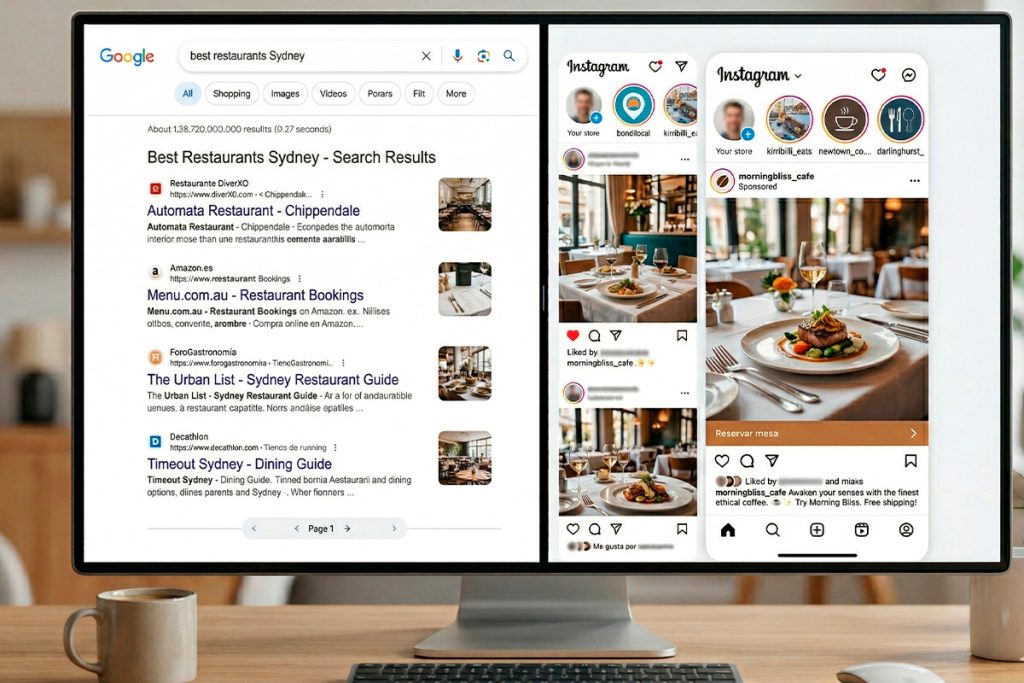
Instagram is where a significant portion of fine dining discovery happens in Australia — a post that stops the scroll is the beginning of a booking journey, not the end of it.
Every post caption should include a soft call to action pointing to your direct booking page. “Reserve your table via the link in bio” after a hero dish shot. “DM us for availability this weekend” after a dining room Reel. “Book directly through our website — link in bio” after an event announcement. Make the path from inspiration to reservation as short as possible.
Your link in bio should go to your reservations page — not your homepage. Use a tool like Linktree if you need to link to multiple destinations, but prioritise “Book a table” as the first and most prominent option.
Instagram Stories are underused as a direct booking tool. A weekly Story featuring the weekend’s specials, with a swipe-up link to your reservations page, is the kind of low-effort, high-intent content that converts followers into guests. Post it every Thursday or Friday when the weekend booking decision is being made.
7. Manage platforms strategically rather than passively
The goal isn’t to disappear from OpenTable or Quandoo entirely — it’s to use them on your terms rather than by default.
Reduce your platform availability during peak periods when you can fill the room through direct channels. During your busiest Friday and Saturday nights, restrict platform availability to a handful of tables and prioritise direct bookings for the rest. During quieter midweek periods, open platform availability wider to fill seats that would otherwise sit empty.
This approach keeps the platforms working as a distribution tool for incremental covers — the ones you wouldn’t have filled anyway — while protecting your margin on the reservations your direct channels would have captured.
Review your platform settings quarterly. Availability that was appropriate six months ago might not reflect your current booking pattern. Adjust based on what your data shows about where your covers are coming from and which nights need the most support.
8. Follow up every no-show and cancellation
No-shows and last-minute cancellations are an unavoidable part of restaurant operations. What’s avoidable is doing nothing with them.
A guest who cancelled with notice is worth following up — they intended to come, something got in the way, and a brief, personal message (“we were sorry to miss you — we’d love to welcome you back”) with a direct booking link converts a meaningful percentage of cancellations into future direct reservations.
A no-show is more delicate, but a simple system — a text message the following morning noting that they were missed and inviting them to rebook — is appropriate in most cases and often recovers the relationship. These guests booked once and didn’t make it. They’re not uninterested — they’re just absent. Stay in contact.
What a realistic shift looks like
A fine dining restaurant currently processing 70% of reservations through platforms and 30% directly, running a structured direct booking strategy for six months, typically sees the following:
Direct reservation share moves to 50–60%. Platform costs reduce by roughly 40%. The guest database grows by 30–40% as direct booking captures contact details that platforms often withhold. Email marketing begins generating measurable repeat visit revenue within three months of the first campaign.
The financial impact depends on cover volume and average cover fee, but for a restaurant doing 150 covers per week at a $6 per-cover platform fee, moving 40% of those covers to direct saves over $18,000 annually — before accounting for the compounding value of the guest database built along the way.
Ready to reduce your platform dependency?
At DIGISAP, we work with fine dining restaurants across Australia on direct reservation strategies — from booking engine setup and Google Ads to email marketing and social media. If you’d like to talk through what’s realistic for your restaurant, we offer a free strategy session with no obligation.
Book a reservations strategy session →