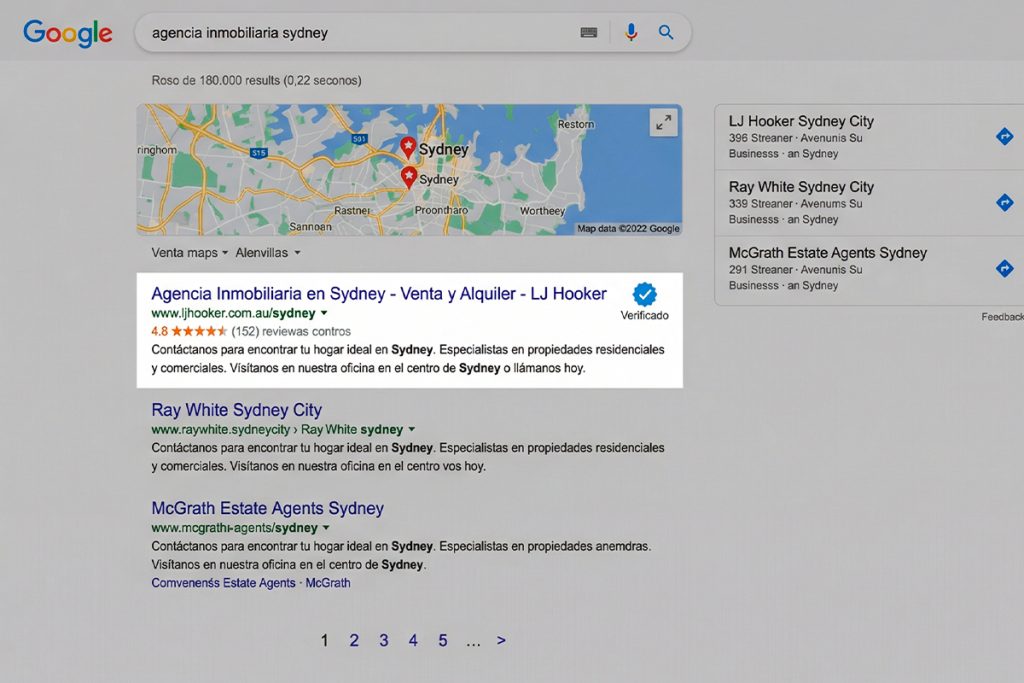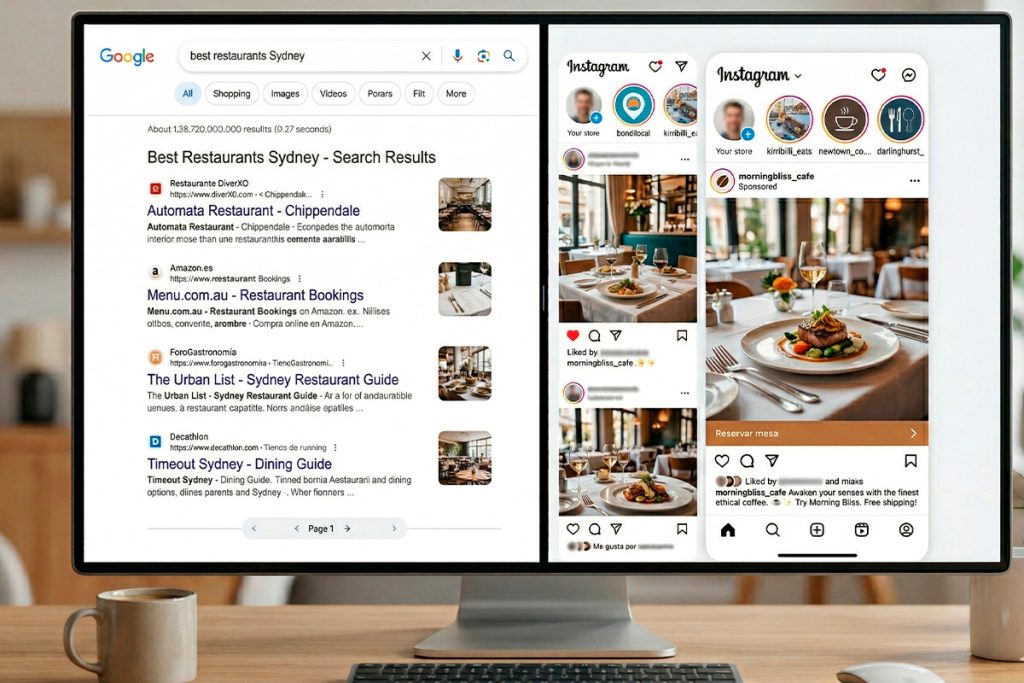
Most real estate agencies in Australia pay to be found. Portal subscriptions, Google Ads, sponsored listings — the traffic is rented, and when the payments stop, so does the visibility.
SEO works differently. A real estate agency that ranks organically for “real estate agent Paddington Sydney” or “investment property Brisbane inner north” receives that traffic for free, indefinitely, without paying per click. The work required to get there is real — it takes time and consistency — but the asset it builds compounds in a way that paid advertising never does.
This guide covers how SEO actually works for real estate agencies in Australia: what to prioritise, what to publish, and what most agencies are getting wrong.
Why SEO matters more for real estate than most industries
Real estate searches in Australia are high in volume, high in intent, and highly local. A buyer searching “3 bedroom house for sale Fitzroy” isn’t casually browsing — they’re in market, they know what they want, and they’re comparing options. An agency that appears organically at the top of that result is getting a free lead that a competitor paid $8–15 for through Google Ads.
The compounding nature of SEO is particularly valuable for real estate, where the consideration cycle is long. A potential seller who finds your agency through a blog post about property values in their suburb in January might not call until June. During those five months, your organic content kept you visible without costing anything extra. Paid ads would have required ongoing spend throughout that period to achieve the same presence.
There’s also the trust dimension. A real estate agency that appears organically at the top of Google results — rather than in an ad box marked “sponsored” — benefits from an implicit credibility signal. Buyers and sellers know that ranking takes sustained effort and expertise. It positions your agency differently from the ones that only appear when they’re paying.
How Google ranks real estate websites
Before building an SEO strategy, it helps to understand what Google is actually evaluating.
Google’s algorithm for local real estate searches weighs three things above most others: relevance (does your content match what was searched?), authority (does Google trust your website?), and local signals (is your agency genuinely connected to the area you’re claiming to serve?).
Relevance is built through content — pages and posts that specifically address the searches your potential clients are making. Authority is built through backlinks — other credible websites linking to yours — and through the technical health of your site. Local signals come from your Google Business Profile, your NAP consistency across the web, and the geographic specificity of your content.
Most real estate agencies are weak on all three. Generic websites with no suburb-specific content, no inbound links beyond the agency’s own portal listings, and a Google Business Profile that was last updated two years ago. The bar to outrank them is lower than it looks.
1. Fix your technical foundations first
SEO strategy built on a slow, broken, or poorly structured website is wasted effort. Before creating content or building links, audit and fix the technical basics.
Site speed
Google uses page speed as a ranking factor, and real estate websites are often slow — heavy with high-resolution photography, unoptimised listing plugins, and outdated themes. Use Google’s PageSpeed Insights to check your score on mobile and desktop. Aim for above 70 on mobile. If you’re below 50, image compression and caching improvements alone can make a significant difference.
Mobile experience
The majority of real estate searches now happen on mobile. A website that isn’t properly responsive — where listings overflow the screen, contact buttons are too small to tap, or the navigation is difficult to use — loses both users and ranking.
Indexing and crawlability
Check Google Search Console to confirm that Google can crawl and index your site correctly. Look for crawl errors, pages marked noindex that shouldn’t be, and any manual actions that might be suppressing your visibility. Fix errors in order of severity — pages that return 404 errors where listings used to live are particularly common on real estate sites and worth addressing promptly.
URL structure
Real estate websites often have messy URL structures generated by their CMS or listing plugin — strings of numbers and parameters that tell Google nothing about the page content. Clean, descriptive URLs — yoursite.com.au/properties/3-bedroom-house-fitzroy — perform better than yoursite.com.au/listing?id=4872&type=res.
2. Build suburb-specific content pages
This is the single most impactful SEO tactic for most real estate agencies — and the one most consistently ignored.
A generic “Properties for sale in Melbourne” page can’t compete with the suburban specificity that a buyer or seller is actually searching for. “Real estate agent Fitzroy,” “houses for sale Newtown Sydney,” “property values Paddington Brisbane” — these searches are won by agencies with content specifically about those suburbs, not generic city-level pages.
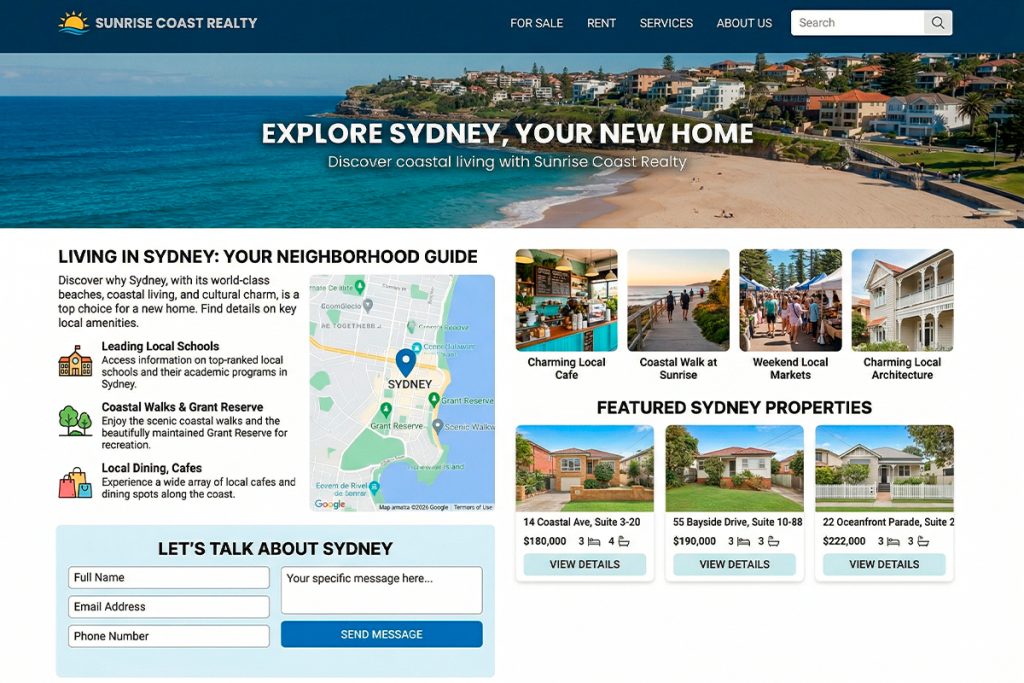
Build a dedicated page for every suburb in your primary service area. Each page should include a genuine description of the suburb — lifestyle, schools, transport, demographics, what makes it distinctive — alongside current market data, recent sales history, and a clear path to enquiry. Include a map, a photo of the suburb, and links to current listings in that area.
These pages don’t need to be long. Four to five hundred words of genuine, specific content outperforms two thousand words of generic copy padded to hit a word count. What matters is that the content is actually about that suburb, written for a buyer or seller genuinely considering it — not assembled from a template with the suburb name swapped in.
Build one page per month. Within a year, a 12-suburb footprint gives you a meaningful local search presence that a competitor with a single city-level page simply can’t match.
3. Create content for sellers, not just buyers
Most real estate agency websites are built for buyers — listings, suburb guides, property search tools. The seller audience is underserved online, which means the competition for seller-focused search traffic is lower and the conversion value is higher.
A vendor who finds your agency through a search for “how much is my house worth in Newtown” or “best time to sell property in Brisbane 2025” is a warmer lead than one who clicked a Facebook ad. They were actively looking for information relevant to their specific situation. Your content provided it. That creates a relationship before the first phone call.
Content that works for seller-focused SEO: suburb-specific market reports published quarterly, guides to the selling process for first-time vendors, articles on seasonal trends in your local market, and comparative analyses of recent sales in key suburbs. None of this requires a journalism background — it requires genuine knowledge of your local market and the discipline to publish consistently.
4. Build your Google Business Profile properly
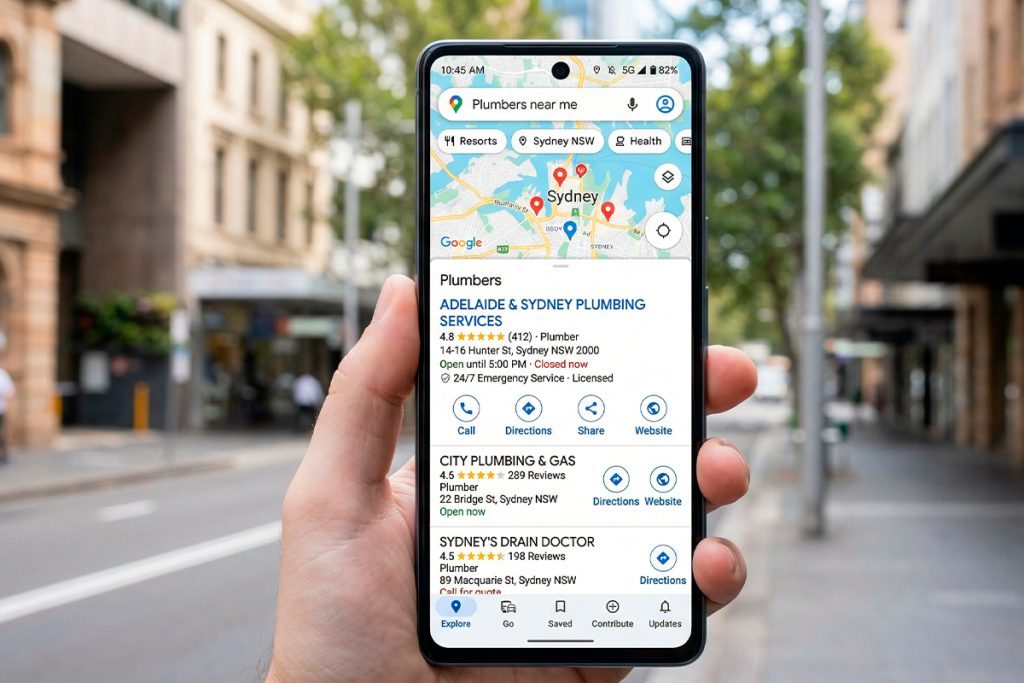
Local SEO for real estate is inseparable from your Google Business Profile. When someone searches “real estate agent [suburb]” on Google Maps, the three agencies that appear in the local pack are determined largely by GBP quality and proximity.
A real estate agency GBP should have: complete and accurate contact information, the correct primary category (“real estate agency”), a full list of services (residential sales, property management, buyer’s advocacy, etc.), a minimum of 20 photos updated regularly, responses to every review, and Google Posts published at least twice a month featuring recent sales, market updates, and team news.
Reviews are particularly important for real estate. A buyer or seller choosing between three agencies of similar reputation will almost always call the one with more recent, detailed Google reviews first. Build review generation into your post-settlement process — a text to the vendor or buyer within 48 hours of settlement, with a direct link to your Google review page, is the most effective and lowest-friction approach.
5. Earn backlinks from credible local sources
Backlinks — links from other websites to yours — are one of Google’s strongest ranking signals. A real estate agency with links from local news outlets, property data providers, industry associations, and suburb-based community websites will rank above an equivalent agency with no backlinks, regardless of how good its content is.
Building backlinks for a real estate agency doesn’t require an outreach campaign. It requires being genuinely useful and visible in your local community online.
Practical backlink sources for real estate agencies: local news sites that cover property market stories (pitch a quote or a suburb market update), property data providers like CoreLogic and Domain who occasionally link to agency research, local business association directories, suburb Facebook groups and community websites that reference local businesses, and real estate industry bodies that list member agencies.
Sponsor local events and ask for a mention on the event website. Write a guest article for a local lifestyle publication about property trends in your area. Contribute data to a local property market report. Each of these generates a credible local backlink that builds your site’s authority over time.
6. Optimise your listing pages
Individual property listings are an underused SEO asset for most real estate agencies. Most listings use templated descriptions that are thin on content and duplicate across multiple listings. Google treats thin, duplicate content as low-quality, which drags down the overall authority of your site.
Write genuine, specific descriptions for every listing — not marketing copy, but descriptive content that answers the questions a buyer genuinely has. Orientation, natural light, storage, parking, the feel of the street, proximity to specific local amenities. This content is useful to buyers and unique to each listing, which is exactly what Google rewards.
Ensure every listing page has a proper title tag and meta description — not auto-generated strings from your CMS, but written descriptions that include the suburb, property type, and a compelling reason to click. These appear in Google search results and directly affect whether a potential buyer clicks your listing over a competitor’s.
When a listing sells, redirect the URL to a sold properties page or a relevant suburb page rather than letting it 404. Every 404 error on a listing that’s been indexed by Google is a small drag on your overall site health.
7. Track what’s actually working
SEO without measurement is guesswork. Set up Google Search Console — it’s free — and connect it to your Google Analytics 4 account. Review both monthly.
In Search Console, look for the keywords driving impressions and clicks to your site. Are the suburb-specific keywords you’re targeting appearing? What’s your average position for your most important searches? Are there keywords driving significant impressions but low clicks — a signal that your title tags and meta descriptions need work?
In Analytics, track organic traffic as a separate channel and measure it against lead conversion events — form submissions, phone calls, and email clicks. Organic traffic that doesn’t convert to enquiries is a content relevance problem. Organic traffic that converts well but is low in volume is a content quantity problem.
Review quarterly and adjust based on what the data shows. The agencies that consistently outperform in local real estate SEO aren’t doing anything exotic — they’re publishing suburb content consistently, maintaining their GBP, and fixing technical issues promptly. The advantage is in the sustained execution, not the strategy.
What a realistic SEO timeline looks like
Real estate SEO is not a fast channel. Set expectations accordingly.
Months 1–2: technical audit and fixes, GBP optimisation, first suburb pages published. Little visible ranking change — Google needs time to recrawl and reindex.
Months 3–4: first organic ranking movements for lower-competition suburb and long-tail keywords. Organic traffic begins to grow from a low base.
Months 5–6: suburb pages start ranking for target keywords. GBP visibility improves in local pack results. First organic leads that can be attributed to SEO content.
Months 7–12: content compounds. Suburb pages rank for multiple keyword variations. Seller-focused content begins attracting vendor enquiries. Backlink acquisition starts lifting domain authority and improving rankings for more competitive terms.
Most real estate agencies that commit to SEO for 12 months see meaningful organic traffic growth and a measurable reduction in reliance on paid portals and Google Ads. The ones that give up at month three because they haven’t seen results yet are the ones paying for the same clicks forever.
Ready to improve your agency’s search visibility?
At DIGISAP, we work with real estate agencies across Australia on SEO strategies built around local search visibility and lead generation — not vanity metrics. If you’d like an independent assessment of where your site currently stands and what’s costing you organic traffic, we offer a free SEO audit with no obligation.
Request a real estate SEO audit