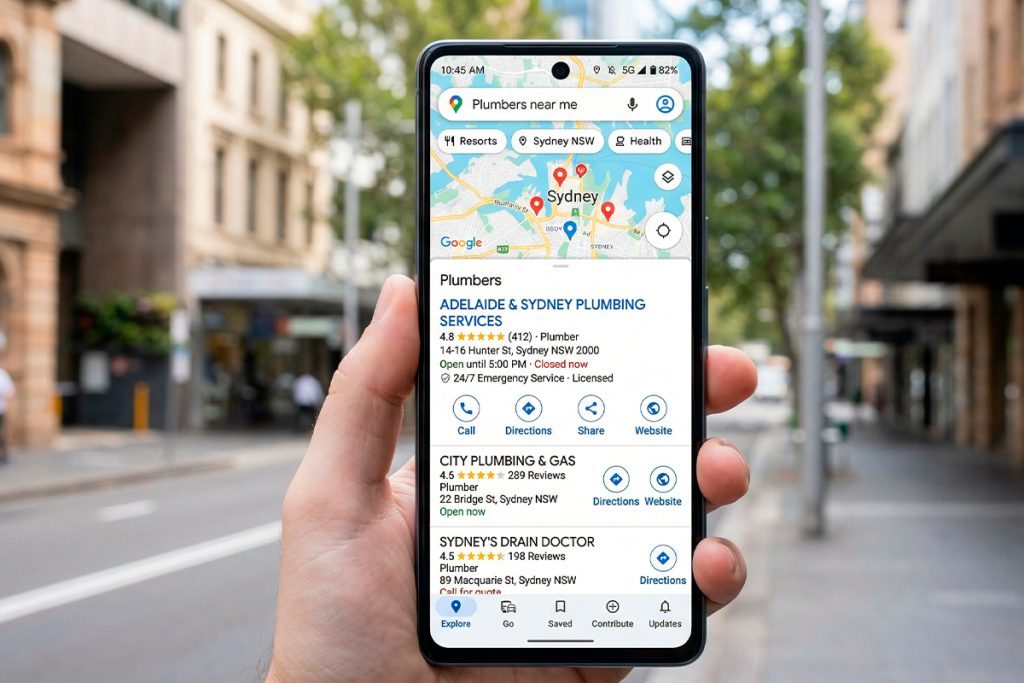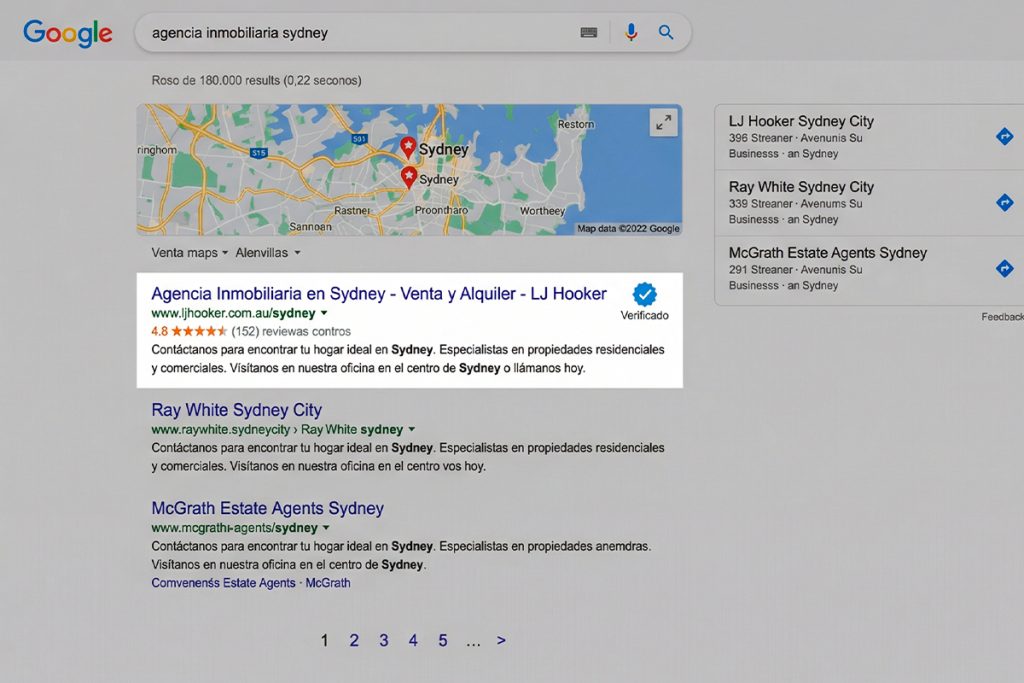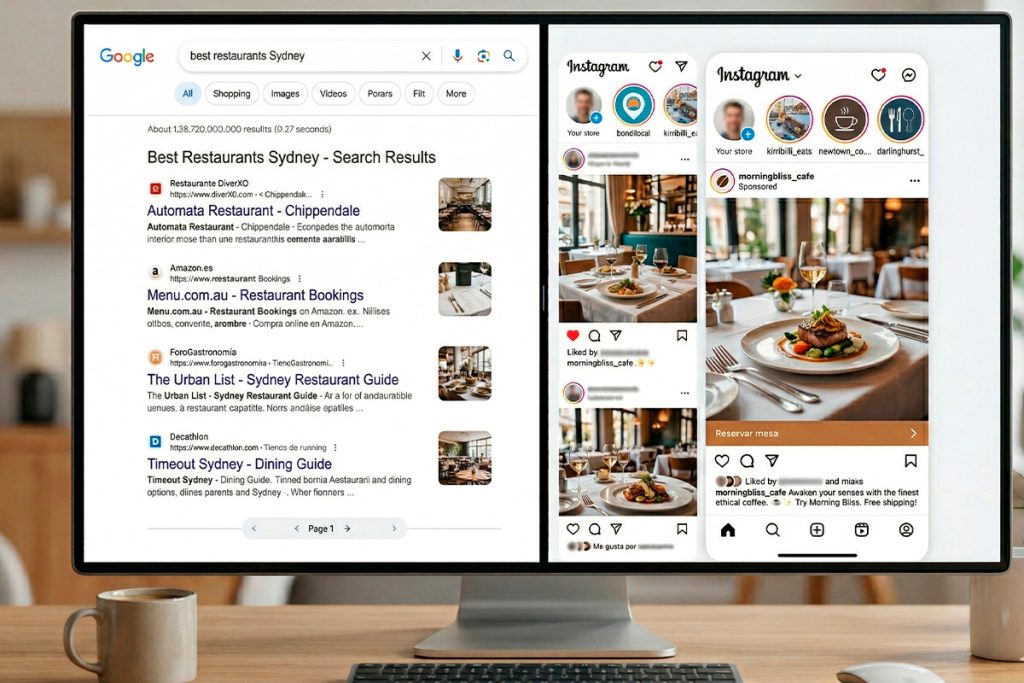
When someone in your suburb searches “electrician near me” or “bathroom renovation company,” three businesses appear in a map at the top of the results before any website links. That map pack — the local three-pack, Google calls it — is where the majority of clicks go. The businesses outside it are largely invisible for that search.
Getting into the local three-pack isn’t a matter of luck or seniority. It’s a matter of doing specific things that most local service businesses haven’t done, consistently. This guide covers exactly what those things are.
What local SEO actually is — and isn’t
Local SEO is the practice of optimising your online presence to appear in geographically relevant searches — primarily in Google Maps and the local pack results that appear above organic links for service-based queries.
It’s different from general SEO in one important way: proximity and local signals matter as much as content quality. A plumber with a mediocre website but an excellent Google Business Profile, 80 recent reviews, and consistent business information across the web will outrank a plumber with a beautifully designed site and no GBP activity, for searches in their shared service area.
That’s both the challenge and the opportunity. Local SEO is not primarily a content game — it’s an operations game. The businesses that win locally are the ones that treat their Google presence as seriously as they treat their physical one.
1. Your Google Business Profile is the foundation
Everything in local SEO for service businesses starts with Google Business Profile. It’s the single most influential factor in local pack rankings — more than your website, more than your domain authority, more than how long you’ve been in business.
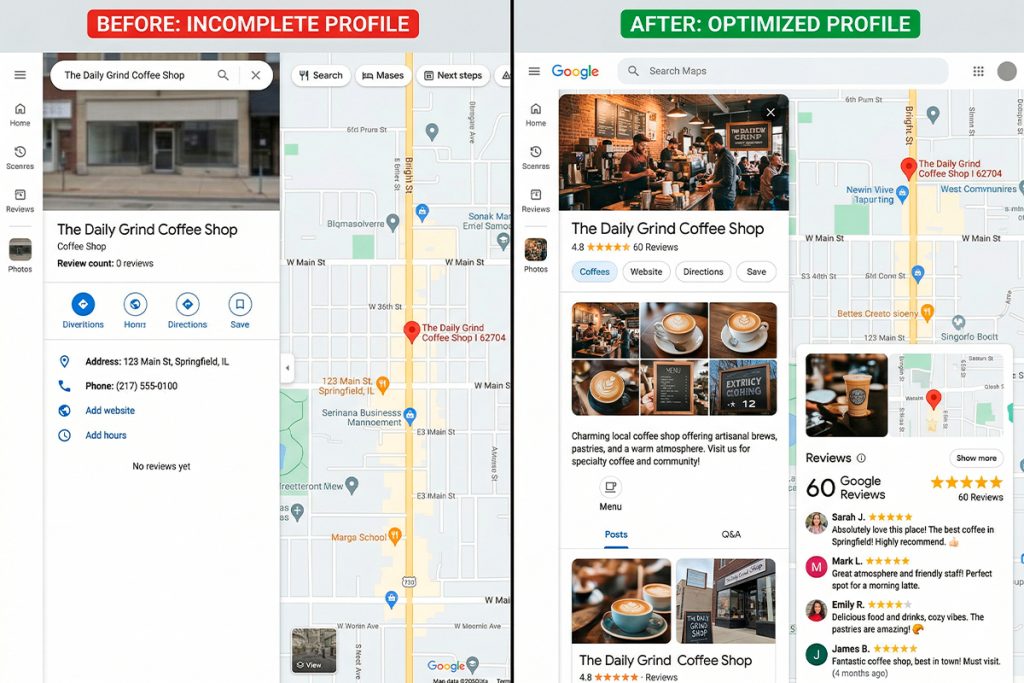
Set it up completely
If you haven’t claimed your GBP, do it today at business.google.com. Verification takes a few days but unlocks the ability to manage every aspect of how your business appears in Google Search and Maps.
Once you have access, fill in every field. Business name exactly as you use it everywhere else. Primary category as specific as possible — “bathroom renovation contractor” rather than just “contractor.” Service area set to the specific suburbs and regions you actually serve, not just your postcode. Phone number, website URL, hours, and a description that mentions your services and location naturally.
Add services explicitly
Google lets service businesses list individual services with descriptions. Use this feature. A plumber who lists “emergency leak repair,” “hot water system installation,” “blocked drain clearing,” and “bathroom renovation” as separate services appears for more specific searches than one who lists only “plumbing services.” Each service is a separate signal to Google about what your business does and for whom.
Photos that show your work
Before and after photos of completed jobs are the highest-performing GBP content for trade and service businesses. They show the quality of your work in a way that copy never can, and they differentiate your profile from competitors with only stock images or basic exterior shots.
Upload a minimum of 15 photos across job types, your team at work, your vehicle or equipment, and your service area if relevant. Update photos monthly — fresh content signals to Google that your profile is actively maintained, which factors into local ranking.
2. Build and maintain review velocity
In local search, review velocity — the rate at which you receive new reviews — matters almost as much as your average rating. A business with 12 reviews and a 4.9 average, all posted two years ago, ranks lower than one with 60 reviews at 4.7 averaging two new reviews per week.
Google interprets recent reviews as a signal that the business is active, trusted, and currently serving clients. A review profile that stopped growing in 2022 tells the algorithm that the business may no longer be operating at its previous level.
How to generate reviews consistently
The most effective approach is the simplest: ask every client personally, within 24 hours of completing the job. A text message — “Hi [name], thanks for having us today. If you’re happy with the work, a Google review would mean a lot to us — here’s the link: [direct link to your review page]” — gets meaningfully higher response rates than a follow-up email a week later when the experience has faded.
Create the direct review link in your GBP dashboard under “Ask for reviews.” It goes straight to the review box — no hunting through Google Maps, no logging in. That frictionless path converts at a much higher rate than “find us on Google and leave a review.”
Responding to reviews
Respond to every review within 48 hours. For positive reviews, acknowledge something specific the client mentioned. For negative ones, stay professional, acknowledge the concern, and offer to continue the conversation offline. Your responses are read by potential clients as much as the reviews themselves — a calm, accountable response to a difficult review builds trust that five-star responses alone can’t.
3. Get your NAP consistent everywhere
NAP stands for name, address, and phone number. Google cross-references your business information across dozens of sources — your website, your GBP, Yellow Pages, TrueLocal, Yelp, industry directories, and anywhere else your business is listed — and uses consistency as a trust signal.
Inconsistencies — a different phone number on Yellow Pages than on your website, an old address still showing on an industry directory, your business name spelled differently across platforms — create doubt in Google’s algorithm and suppress local rankings.
Audit your NAP data across the major directories relevant to your industry. For trades and home services: Yellow Pages, TrueLocal, Hipages, Houzz, ServiceSeeking. For professional services: LinkedIn, industry association directories, local chamber of commerce listings. Fix any discrepancies so every instance of your business information is identical — same spelling, same format, same phone number, same address.
This is unglamorous work. Most businesses don’t do it. That’s exactly why it’s an opportunity.
4. Build suburb-specific pages on your website
Your website’s local relevance — how specifically it addresses the geographic areas you serve — is the second major factor in local search rankings after your GBP.
A service business website with a single “service areas” page listing fifteen suburbs in a bulleted list tells Google very little about your genuine local presence. A website with dedicated pages for each primary suburb — each with specific content about your work in that area — tells Google a great deal.
A suburb service page doesn’t need to be long. Three to four hundred words covering: what services you offer in that suburb, why you serve it (proximity, established client base, specific local knowledge), a testimonial from a client in that suburb if you have one, a photo of a completed job in the area if possible, and a clear contact form.
The content needs to be genuine — not a template with the suburb name swapped in. Google is increasingly good at identifying thin, duplicated content, and suburb pages that are essentially identical except for the location name provide little ranking benefit and can actively harm your site’s authority.
Build one page per month for your highest-priority suburbs. Within six months, a six-suburb footprint gives you a local search presence that competitors with a single city-level page can’t match for suburb-specific queries.
5. Earn local backlinks
Backlinks — links from other websites to yours — are one of Google’s strongest ranking signals for both local and general SEO. For local service businesses, the most valuable backlinks come from websites that are themselves locally relevant: local news outlets, suburb-based community websites, local business associations, and industry directories with genuine authority.
You don’t need dozens of backlinks. For most local service businesses, five to ten high-quality local backlinks make a meaningful difference to local rankings — particularly when combined with strong GBP optimisation and good review velocity.
Practical ways to earn local backlinks as a service business: get listed in your local chamber of commerce directory, contribute a quote or case study to a local news story about home renovation trends, sponsor a local community event and get a mention on their website, get listed on industry association websites, and ensure your business is on every relevant trade directory that carries a genuine local backlink.
Don’t pay for backlinks from link farms or generic directories. Low-quality backlinks from irrelevant sources provide no ranking benefit and can trigger Google penalties that are difficult to recover from.
6. Create content that answers local questions
Beyond suburb service pages, content that answers the specific questions your local clients are searching provides a second tier of local organic visibility that compounds over time.
For a renovation contractor in Melbourne, useful content might include “how much does a bathroom renovation cost in Melbourne in 2025,” “do I need a building permit for a home extension in Victoria,” and “how to find a licensed builder in inner Melbourne.” These are searches made by homeowners in the research phase — people who are not yet ready to get quotes but are actively gathering information.
Content that answers these questions accurately and specifically attracts organic traffic from people who are three to six months away from being ready to engage a contractor. If your content is what helped them understand the process, your business is the one they think of first when they’re ready to call.
Publish one piece of genuinely useful local content per month. Over a year, twelve articles targeting research-phase local queries builds a meaningful organic traffic asset that generates leads indefinitely.
7. Track your local rankings and adjust
Local SEO without measurement is guesswork. Set up Google Search Console — it’s free — and connect it to your Google Analytics 4 account.
In Search Console, look for the local keywords driving impressions to your site. Are you appearing for suburb-specific service searches? What’s your average position for your most important queries? Which pages are driving the most organic clicks?
Also use Google Maps to check your own local three-pack visibility for your target searches — do it from a device located in your service area, or use a local rank tracking tool that simulates searches from specific postcodes. Your GBP ranking varies significantly by the searcher’s location relative to your listed address and service area.
Review monthly. The businesses that consistently win in local search aren’t doing anything exotic — they’re maintaining their GBP actively, collecting reviews systematically, fixing NAP inconsistencies promptly, and publishing local content regularly. The advantage is in the sustained execution over time, not in any single tactic.
What a realistic local SEO timeline looks like
Local SEO results are faster than general SEO but slower than paid advertising. A realistic timeline for a service business starting from a weak local presence:
Month 1: GBP claimed and fully optimised, NAP audit completed and inconsistencies fixed, review generation process started. No visible ranking change yet — Google needs time to process the updates.
Months 2–3: first ranking movements for lower-competition local queries. Review velocity building. Suburb pages going live.
Months 4–6: consistent appearance in local three-pack for primary service and suburb combinations. Organic enquiries starting to arrive from local searches. Review count growing noticeably.
Months 7–12: local pack presence stable across primary service area. Suburb pages ranking for multiple keyword variations. Backlink building contributing to broader local authority. Organic enquiries as a meaningful share of total lead volume.
The businesses that commit to this timeline — and treat local SEO as an ongoing operational discipline rather than a one-time project — consistently outperform competitors who rely entirely on paid advertising to generate local leads.
Ready to improve your local search visibility?
At DIGISAP, we run local SEO audits and optimisation campaigns for service businesses across Australia — trades, renovation contractors, professional services, and home service businesses. If you’d like an independent assessment of where your local search presence currently stands and what’s costing you inbound enquiries, we offer a free audit with no obligation.